10 Tips For Training Your Pet Parrot
Parrots are wonderful pets. You will quickly find that these birds are extremely smart, and their learning ability makes them fun to train.
Remember that any animal that shows signs of high intelligence can quickly get bored, so your job is to train your pet parrot and spend the time it takes to make your bird into a wonderful pet.
It takes time and patience to train a parrot, but with the proper training, your parrot will provide you with many years of friendship.
You can train your parrot by following a few steps.

- Complete bird training clicker kit: Includes one box clicker, one 9-inch acrylic bird target stick and one bird-focused training reference card for convenient, consistent practice
- Clear target for short sessions: The smooth acrylic bird training stick provides a visible point for target training and is easy to wipe clean between uses
- Positive reinforcement training: Pair the click sound with a reward to mark desired behavior during step-up practice, station training, recall games and simple tricks
- For many companion birds: Designed for parrots, parakeets, budgies, cockatiels, conures, lovebirds, macaws, cockatoos and other pet birds; supervise use
- Training reminder: Introduce the clicker and target stick gradually, keep sessions short, reward desired behavior and supervise your bird during use
Last update on 2026-10-18 / Affiliate links / Images from Amazon Product Advertising API
10 Tips For Training Your Pet Parrot
Training a parrot can be a rewarding experience that strengthens your bond and enhances your pet’s quality of life.
Here are ten tips to help you train your parrot effectively.
- Start Early
- Begin training as soon as your parrot is comfortable in its new environment. Younger birds are usually more receptive to learning new things, but older birds can also be trained with patience.
- Establish Trust
- Spend time daily interacting with your parrot in a calm, non-threatening manner. Trust is the foundation of any successful training program.
- Use Positive Reinforcement
- Reward desired behaviors with treats, praise, or playtime. Positive reinforcement encourages your parrot to repeat those behaviors.
- Keep Training Sessions Short
- Parrots have short attention spans. Limit training sessions to 10-15 minutes to keep them engaged and prevent frustration.
- Be Consistent
- Use the same words and gestures for commands each time. Consistency helps your parrot understand and remember what you’re asking of it.
- Train Before Meals
- A slightly hungry parrot is more motivated to comply with training for food rewards. However, never withhold food as punishment.
- Minimize Distractions
- Train in a quiet, familiar environment to help your parrot focus on you and the training session.
- Teach One Command at a Time
- Focus on one skill or command until your parrot masters it before introducing another. This prevents confusion and builds confidence.
- Practice Patience
- Be patient, and never punish your parrot for not understanding or following a command. Punishment can lead to fear and trust issues.
- End on a Positive Note
- Always conclude training sessions with a command your parrot has mastered, followed by a reward. This ensures the experience ends positively, leaving your parrot looking forward to the next session.
Following these tips will create a fun and effective training routine you and your parrot will enjoy.
When school is in for your parrot, removing it from its cage and training it in a small, quiet space is best. Your parrot is likelier to remain attentive and retain information in a new environment.
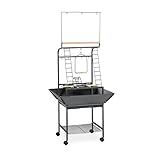
- 5 FOOT PARROT PLAYSTAND – Activity center as a cage add on for supervised, enriching time with your bird. Features eight toy hoops for hanging a variety of treats and toys
- HIGH QUALITY MATERIALS – This bird play stand is made from metal with a durable black hammertone finish, including stainless steel bowls for water and feed, as well as a pull-out debris tray
- VERSATILE ENTERTAINMENT – Birds will be able to engage in climbing, swinging, and exploring with multiple perches at different heights, three ladders, and rings and hooks hanging toys and accessories
- EASY TO ASSEMBLE & CLEAN – Has pull-out drawer and rounded corner seed guard for quick cleaning. Bottom storage shelf keeps extra treats and toys handy. Measures 17.625 in. L x 16.5 in. W x 59 in. H
- ABOUT PREVUE PET – Since 1869, Chicago-based Prevue Pet Products has built a well-deserved reputation for safe, high-quality, well-designed products for domesticated pets and their human companions
Last update on 2026-10-18 / Affiliate links / Images from Amazon Product Advertising API
It would be best if you also eliminated all distractions in your home. If your parrot becomes distracted during training, it will not learn well.
You must turn off the radio, television, and even the telephone. Also, remember that parrots are a lot like children. They have short attention spans, so short training sessions are recommended.
In addition, try to plan your parrot’s training time around their schedule, not yours after mealtime is always a good time for training because your parrot will be content and will pay attention.
Your parrot will also appreciate plenty of praise. Even if you are not very successful, do not let your parrot see your stress levels rise.
This makes it an unpleasant experience for your bird, and you will have a harder time getting your parrot interested in learning in the future.
When you are ready to teach your parrot a new trick, your pet parrot will respond well to treats and praise.
Remember that all animals respond better to praise than punishment.
Avoid punishing your parrot, even if he or she is acting naughty. Ignoring this behavior is your best bet when training your pet parrot.
Parrots do not understand punishment or negative reinforcement. If you respond to your parrot’s bad behavior, your pet may see this as positive attention.
Remember that while your parrot will love food treats as rewards, try to accentuate the positive and encourage good behavior with lots of praise and playtime.
Otherwise, your parrot may only perform the tricks you want when some food reward is available.
Repetition is the key to successfully training your pet parrot.
The best way to train your parrot to perform is to repeat these basic steps repeatedly until your pet gets the trick.
This works well for basic commands and advanced tricks. If you have just gotten your pet parrot, start with simple tricks, such as teaching your parrot to sit on your finger on command.
Find a word for each trick and use it every time you train. Most of all, never force your parrot to train. If you find your parrot tired or uninterested, stop and try again.
You can move your training session closer to the bird’s cage as your parrot learns more commands and tricks.
As they get better at their new skill, they will feel comfortable performing in their cage and in the hustle and bustle of their household.
Birds learn quickly in most cases, and sometimes just by listening when not in training, which may cause embarrassment to you if they learn something inappropriate.
Training a parrot takes a lot of time and patience.
You must love your bird and have a lot of time and dedication to make this partnership worthwhile.
With patient training and love, you have a fantastic and well-behaved pet that will be with you for a long time.